A white tent or marquee in direct Zimbabwean sun is one of the most inhospitable event spaces you can create. The fabric traps heat, the air inside goes still, and by midday the temperature inside is often ten to fifteen degrees hotter than the temperature outside. Put two hundred guests in that space and the body heat makes it worse. This guide explains how to cool a tent or marquee effectively, what actually works, and what does not.
Why tents get so hot
A marquee or tent acts like a greenhouse. Sunlight passes through or heats the fabric, the air inside absorbs that heat, and there is no natural ventilation to carry it away. White fabric is better than coloured because it reflects more sunlight, but it still traps convective heat underneath. Once the air heats up inside the tent, it stays hot — there is no air conditioning duct, no extractor fan, no stack effect to draw it upward and out.
Body heat compounds the problem dramatically. A seated adult generates roughly 100 watts of heat. Two hundred guests are adding 20 kilowatts of body heat to a space that is already overheating from the sun. Add catering equipment, lighting, sound gear and the bodies of the crew, and the heat load is substantial.
The hottest areas in Zimbabwe — Victoria Falls, Kariba, the Lowveld, Bulawayo — make this worse because the starting temperature is higher. A tent in Harare in October is uncomfortable. The same tent in Victoria Falls or Kariba in October, where ambient temperatures push into the high thirties and low forties, is genuinely dangerous for seated elderly guests.
What does not work: conventional aircon in a tent
A conventional air conditioner — a split unit, a portable air conditioner with a hose — is designed to cool a sealed room. It works by extracting heat from the air inside and pumping it outside through an exhaust. For this to work, the room has to be sealed: closed walls, closed windows, closed doors. The air conditioner then chills the fixed volume of air inside that sealed space.
A tent is not a sealed space. The sides are open, or the gaps at the base let air flow freely. A portable air conditioner in a tent is cooling the outdoors through the openings — the compressor runs, the electricity burns, and the temperature inside the tent does not change. This is the single most expensive cooling mistake people make at events, and it is surprisingly common.
What works: evaporative air coolers (portable aircon)
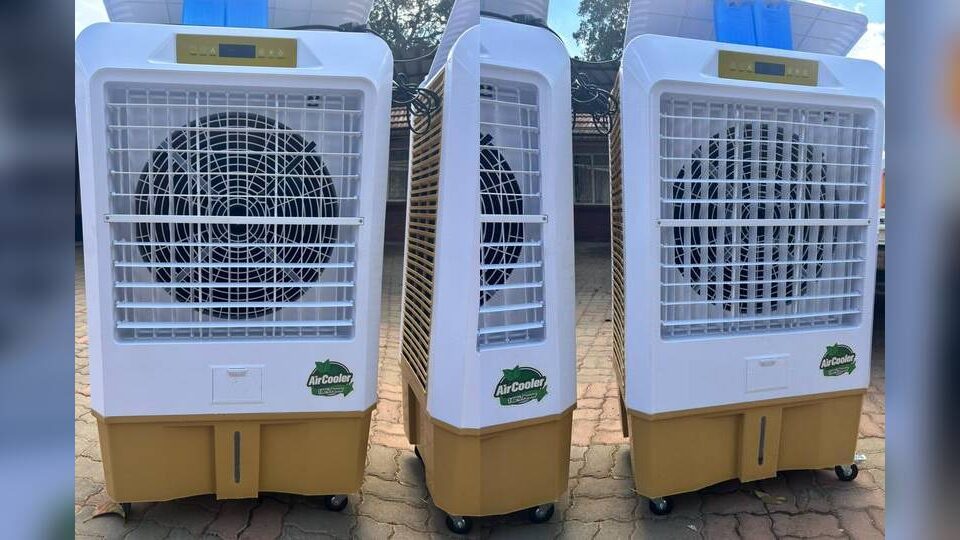
The machine that actually cools a tent is a mobile evaporative air cooler — the unit that gets called a portable aircon, an aircon fan, a cold fan, an air cooler or a desert cooler, depending on who is selling it. It works by pulling air through water-soaked honeycomb pads. The water evaporates, which absorbs heat from the air, and the air comes out the other side cooler and moving.
This is fundamentally different from a conventional aircon because it does not need a sealed space. It is not trying to chill a fixed volume of air — it is producing a continuous stream of cooled air. That stream is what you aim across the seating area. The air passes through the seated guests, carrying heat away from them, and exits through the gaps in the tent. Fresh hot air is drawn in from outside, passes through the cooler, comes out cold, and the cycle continues.
In Zimbabwe's dry hot season — August to the rains — this is exceptionally effective. Evaporative cooling depends on dry air: the drier the air, the more water can evaporate into it, and the greater the temperature drop. The build-up months before the rains are hot and dry, which is exactly the condition these machines are designed for.
What about fans?
A plain fan — a tower fan, a pedestal fan — moves air without cooling it. On a mildly warm day the air movement creates a wind-chill effect that feels pleasant. In a tent in October in Harare, Bulawayo or Victoria Falls, a fan is circulating air that is thirty-five to forty degrees. It helps a little. It is not a solution.
If you have used fans at a tent event before and found they were not enough, the step up is an evaporative air cooler — a cold fan, an aircon fan. It combines the air movement of a fan with genuine temperature reduction. The air coming out is measurably colder than the air going in, not just faster.
How many air coolers do you need for a tent?
One unit does not cool a whole marquee — it cools the area it is pointed at. Coverage comes from placing several units around the perimeter, angled inward so their cooled airflow crosses the entire seating area. The number depends on four things: the tent footprint, how many people are in it, how open the sides are, and how hot the day is.
As a rough guide for a standard marquee: a small tent for 50–80 guests might need two to three units. A mid-size tent for 150–200 guests might need four to six. A large tent for 300+ guests could need eight or more. These numbers go up if the tent is fully enclosed, if it is in direct sun all day, or if the event is in one of the hotter areas like Victoria Falls or Kariba.
The honest way to get the right number is to tell us the tent dimensions, the guest count, the location and whether the sides are open or closed. We will tell you what the space actually needs, which is sometimes more and sometimes less than you expect.
Placement matters as much as quantity
Units at the perimeter blowing inward across the seating are more effective than units at the front blowing at the first few rows. The goal is to create a cross-flow of cooled air that reaches the whole seating area, not to freeze the tables nearest the machine while the rest of the tent stays hot.
Avoid placing units directly behind a speaker or a performer — the airflow creates noise that a microphone will pick up. If you are hiring sound as well as cooling, tell the crew at setup so they can position the coolers where they cool the room without interfering with the audio. This is a detail that cooling-only suppliers routinely miss and that every organiser notices when it goes wrong.
Other things that help cool a tent
Open the sides wherever wind direction and privacy allow. Natural cross-ventilation is free and it helps the coolers do their job by drawing cooled air through the tent and pushing warm air out. If the tent has sidewalls that roll or clip, open the ones on the windward and leeward sides to create a through-draft.
Time of day matters. If you can schedule the seated portion of your event for late afternoon rather than midday, the temperature drops significantly. A wedding ceremony at four in the afternoon is a different thermal experience to a wedding ceremony at noon, even in the same tent.
Colour of the tent matters marginally — white reflects more heat than darker colours. Lining inside the roof creates an insulating air gap that reduces radiant heat. If the tent provider offers a roof lining, it is worth taking.
Cooling a tent in Victoria Falls, Kariba, Bulawayo and Harare
The hottest areas in Zimbabwe are Victoria Falls and Kariba in the Zambezi valley, where October temperatures regularly push into the high thirties and low forties. Cooling a tent at the Falls or at Kariba is not optional — it is a health and comfort issue for seated guests. Air coolers work exceptionally well here because the valley air is dry, which maximises the evaporative effect.
Bulawayo heats up through the same months, and Matabeleland's dry conditions make evaporative cooling highly effective. Harare is milder but still hot enough from September through November that a tent without cooling is uncomfortable. In all four cities, the hot season and the event season overlap — and that is when demand for air coolers is at its peak.
Book cooling when you book the tent and the sound, not the week before the event. Cooler stock across the whole country is committed early in the season, and the units that are still available in late October are the ones nobody needed — which is usually none.
Frequently asked questions
Can you air condition a tent?
Not with a conventional air conditioner — it needs sealed walls to work. You can cool a tent effectively with evaporative air coolers (portable aircon units), which are designed for open and semi-open spaces. They lower the air temperature by evaporating water, and they work best in Zimbabwe's dry hot season.
How many air coolers do I need for a wedding marquee?
It depends on the tent size, guest count, whether the sides are open, and the temperature. As a rough guide: 50–80 guests might need two to three units, 150–200 guests might need four to six, and 300+ guests could need eight or more. Tell us the details and we will give you the right number.
Are fans enough to cool a tent?
Usually not. Fans move air without lowering its temperature, so in a hot tent they circulate hot air. Evaporative air coolers — cold fans — actually drop the temperature of the air. If you have tried fans and found they were not enough, air coolers are the step up.
Do air coolers work in Victoria Falls and Kariba?
Extremely well. Evaporative cooling is most effective in hot, dry conditions, and the Zambezi valley delivers exactly that during the build-up months. Victoria Falls and Kariba are among the best environments for these machines anywhere in Zimbabwe.
Need a hand with your event?
Tell us what you're planning and we'll recommend and supply the right equipment.
Get a Quote