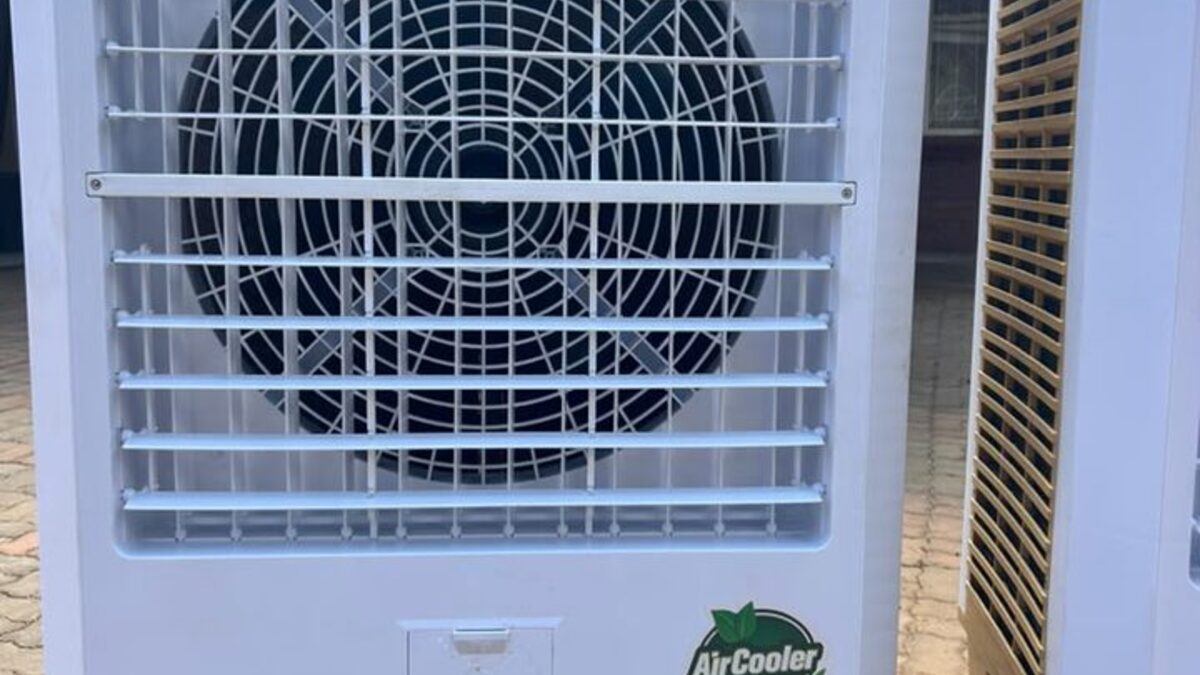
Go looking for cooling in Zimbabwe and the terminology will defeat you before the shopping does. The same machine is advertised as an air cooler, a portable aircon, an aircon fan, a water cooled fan and a portable air conditioner — sometimes within a single listing. People end up hiring or buying the wrong thing for their space with fair regularity, and it is an expensive mistake to discover on the day of an event.
There are really only two different machines underneath all those names. Once you can tell them apart, the right choice for your space becomes obvious.
Machine one: the evaporative air cooler
This is the one you will most often be offered, and it has no compressor and no refrigerant gas. A pump keeps a set of honeycomb pads wet, a fan pulls air through those wet pads, and some of the water evaporates into the air as it passes. Evaporation absorbs heat, so the air comes out the other side cooler than it went in — and moving, which matters as much as the temperature.
Because there is no refrigeration cycle, there is nothing to install. No exhaust hose, no window kit, no gas. You fill the tank, plug it into a normal socket and switch it on. Power consumption is a small fraction of what an air conditioner draws.
The critical characteristic is that it does not need a sealed room. It is not trying to chill a fixed volume of air — it is producing a continuous stream of cooled air. That means it works perfectly well in a marquee, a tent, an open-sided hall or a warehouse with the doors up, which is where most cooling in Zimbabwe is actually needed.
Machine two: the refrigerant portable air conditioner
This is a real air conditioner on wheels. It has a compressor and refrigerant gas inside, exactly like a wall-mounted split unit or the air conditioning in a car, and it works by extracting heat from the room and dumping it somewhere else. That heat has to go somewhere, which is why these units always have a fat exhaust hose that has to vent out of a window.
It genuinely lowers the temperature of a sealed room, and it does so regardless of how humid the air is. Some models run the cycle in reverse to heat as well, which is where the “heat and cold” wording in local listings comes from. It also draws considerably more power, and it is useless in any space that is open to the outside — because it is then simply trying to cool the outdoors through the opening.
So which one do you need?
Ask one question: is the space genuinely sealed? A marquee, a tent, a boma, a covered terrace, an open-sided hall, a warehouse with the doors up, a church hall with every window open in October — none of these are sealed. All of them want an evaporative cooler, and a refrigerant unit will disappoint you in every one of them.
A small office with a window you can run a hose through, a bedroom, a server room, a closed meeting room — these are sealed, they are small, and a refrigerant portable air conditioner will cool them properly in a way an evaporative cooler will not.
There is a third case worth naming because it catches people out: a large closed hall with a few hundred people in it and no working air conditioning. Technically sealed, but far too big for portable refrigerant units to make any impression on. Here, evaporative coolers placed to move cooled air across the seating are what actually work.
What about tower fans and “air cooling fans”?
A tower fan is a fan. It moves air without changing its temperature, which helps a little through evaporation off your skin, but on a genuinely hot day it is circulating hot air. Useful at a desk, not a solution for a function.
“Aircon fan”, “air conditioner fan”, “air cooling fan” and “water cooled fan” are almost always evaporative coolers — usually the small domestic kind with a few litres of water in the base. Same principle as a commercial unit, a tiny fraction of the output. A unit that cools a bedroom nicely will do essentially nothing in a marquee with two hundred people in it, and that mismatch is the single most common cooling mistake we get called in to fix.
“Desert cooler” is the same machine again — a term more common in South Africa and India that appears in listings here. If someone has quoted you a desert cooler, they have quoted you an evaporative air cooler.
The one real limitation to know about
Evaporative cooling depends on dry air. The drier the air, the more water evaporates into it and the bigger the temperature drop. In very humid conditions the air is already close to holding all the water it can, so less evaporates and the cooling effect shrinks — the unit starts behaving more like a strong fan.
In Zimbabwe this works decisively in your favour. Our hot season is the dry build-up from around August to the break of the rains, which is exactly when cooling is needed and exactly the condition evaporative units are best at. Once the rains set in and humidity climbs, the heat has usually broken anyway.
The short version
If your space is open to the outside in any way, you want an evaporative air cooler, and it is the right machine rather than the cheap compromise. If it is a small sealed room you can vent a hose from, you want a refrigerant portable air conditioner. If someone is selling you a domestic water-tank fan for a function tent, walk away.
JMG Audio hires out commercial evaporative air coolers in Harare and across Zimbabwe, and we will tell you honestly when cooling is not what your problem needs.
Frequently asked questions
Is an air cooler the same as an air conditioner?
No, though the terms get used interchangeably in Zimbabwe. An air cooler is an evaporative unit that cools air by evaporating water into it — no gas, no compressor, no installation, works in open spaces. An air conditioner uses refrigerant and a compressor to remove heat from a sealed room, and needs somewhere to vent that heat to. They suit completely different situations.
Can a portable air conditioner cool a marquee?
Not usefully. A refrigerant unit works by chilling a sealed volume of air, and a marquee is open to the outside, so it is effectively cooling the outdoors through the gap. An evaporative air cooler is the correct machine for marquees, tents and open-sided venues because it delivers a stream of cooled moving air rather than trying to seal and chill a room.
Do air coolers use a lot of electricity?
No — that is one of their main advantages. With no compressor to run, an evaporative cooler draws a small fraction of what a comparable air conditioner uses, and will run comfortably on a generator. Just remember to count the coolers in the load when a generator is being sized for an event.
Do air coolers make a room damp?
They add some moisture to the air, which is exactly how the cooling works. In a dry, well-ventilated space — which describes almost every Zimbabwean event venue during the hot season — this is not noticeable and is often pleasant. In a small, closed, already-humid room it would be, which is another reason evaporative coolers belong in open and semi-open spaces.
Need a hand with your event?
Tell us what you're planning and we'll recommend and supply the right equipment.
Get a Quote