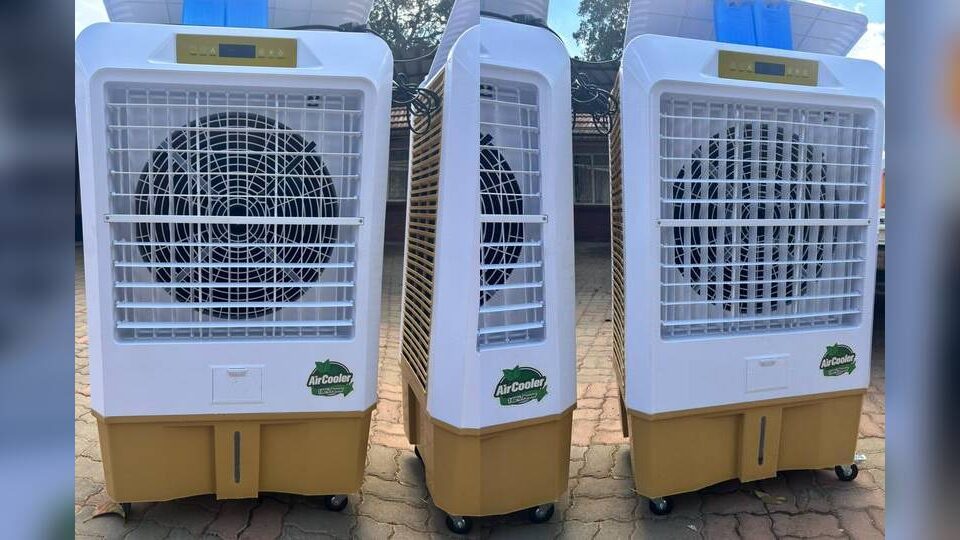
Zimbabwe’s hot season is unforgiving, and a marquee or a packed hall in October can undo months of careful planning in a single afternoon. JMG Audio operates a fleet of commercial-grade mobile air coolers — high-output evaporative units, also known as portable aircons — for hire in Harare and delivered nationwide. Each unit rolls into position on castors and runs from an ordinary wall socket, delivering cool, continuously moving air across the whole seated area. We supply them in the quantities your venue actually requires, so your guests stay comfortable and your programme holds their attention from the first item to the last.
What you are actually hiring
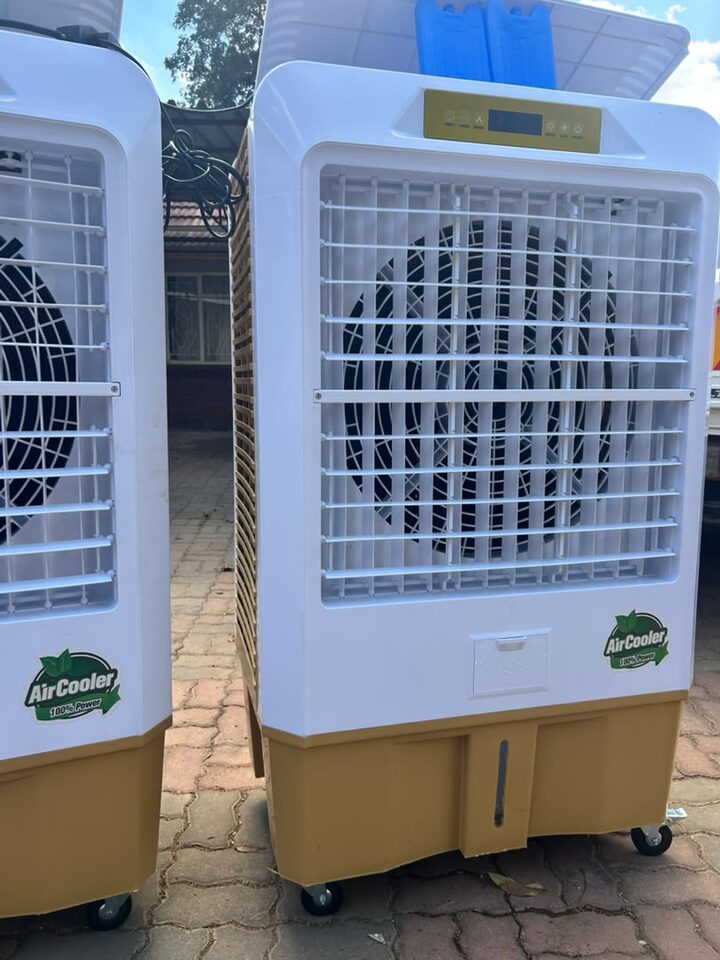
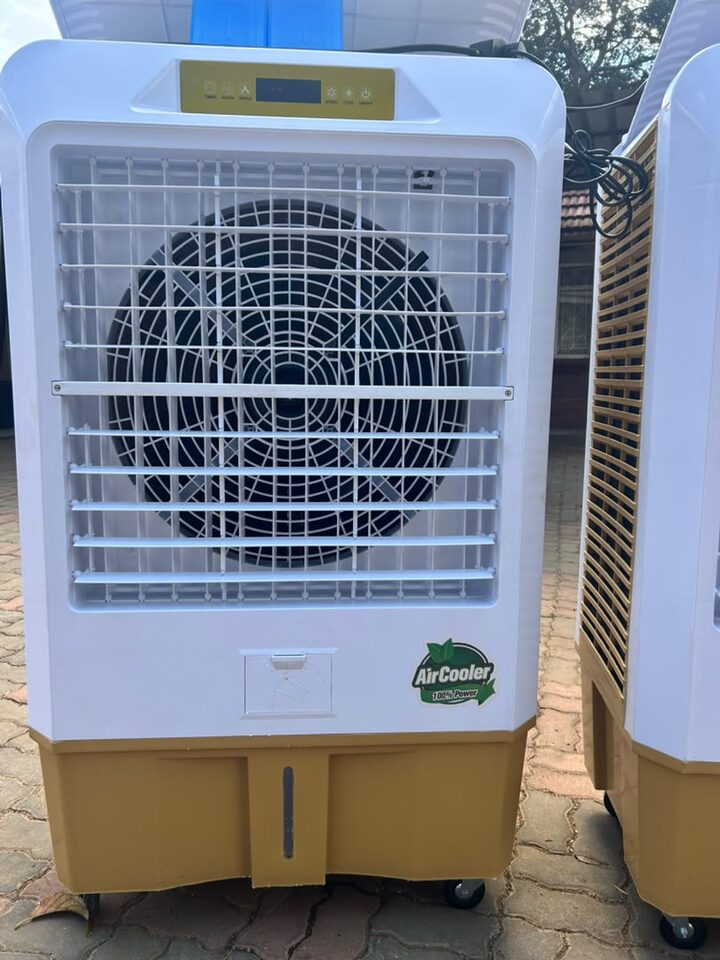
Our fleet is made up of full-size commercial evaporative air coolers — an entirely different class of machine to the domestic units sold with a small water tray. Each one stands roughly chest height on lockable castors, with a large axial fan behind a front grille, honeycomb cooling pads down three sides, a deep water tank with a level indicator, and a digital control panel for fan speed, swing, cooling mode and timer. Ice packs drop into the tank when you want output colder still.
The working principle is simple and that is the point: a pump wets the honeycomb pads, the fan pulls air through them, and the air comes out the front cooler and moving. There is no compressor, no gas and no exhaust hose to route out of a window — which is exactly why these units work in places a conventional air conditioner cannot be installed at all.
They run quietly enough to sit through a speech or a service. And because JMG Audio has spent years building event sound, we position every unit where it cools the room without ever intruding on a microphone — a detail cooling-only suppliers routinely miss, and one every organiser notices the moment it goes wrong.
Air cooler, portable aircon, evaporative cooler — is there a difference?
In Zimbabwe these terms get used interchangeably, and it causes real confusion when people are trying to hire. Walk through Harare classifieds and you will see the same style of unit advertised as an air cooler, a portable aircon, an aircon fan, a water cooled fan and a portable air conditioner, sometimes in the same listing. So it is worth being straight about what is what.
An evaporative air cooler — what we hire — cools air by evaporating water into it. It needs water topped up, it works best when the air is dry, it uses a fraction of the power of an air conditioner, and it will happily cool a space with the sides open. A true portable air conditioner is a refrigerant unit with a compressor that pumps heat out through a hose, needs a sealed room to work properly, and draws far more power.
For the overwhelming majority of Zimbabwean event venues — marquees, tents, open-sided halls, churches, boma areas, warehouses, workshops — the evaporative cooler is not the compromise option, it is the correct one. A refrigerant unit in a marquee is simply cooling the outdoors. If you searched for portable aircon hire and landed here, this is almost certainly the machine you were looking for.
Where air coolers earn their keep
Marquees and tents are the obvious one. A white marquee in Zimbabwean sun acts like a greenhouse by mid-morning, and by the time guests are seated for a wedding lunch or a prize-giving the air inside is noticeably hotter than outside it. Coolers placed around the perimeter, blowing inward across the seating, change that completely.
Church halls and conventions are the other big use. A congregation fills a hall with body heat faster than anything else, and a multi-day convention in the hot season is genuinely hard going without air movement. The same applies to school prize-givings, graduations and any event where a lot of people sit in one room for several hours.
Beyond events, we hire coolers to warehouses, workshops, factory floors, clinics, salons, offices with failing air conditioning, and site offices — anywhere a fixed system does not exist, is broken, or cannot cope with the space. Short-term hire covers the hot months without the cost of installing something you only need for a quarter of the year.
Zimbabwe’s cooling season — and why to book early
Air cooler demand in Zimbabwe follows a short, sharp curve. It starts building in August, peaks through September, October and early November as the heat climbs towards the break of the rains, and then falls away once the wet season sets in and the humidity rises. That is a window of a few months, and every organiser in the country discovers they need cooling within the same few weeks of it.
The practical consequence is that our cooler stock is committed a long way before the hottest days actually arrive. If your wedding, conference, convention or prize-giving falls between August and the rains, the time to add coolers to your quote is when you book the sound — not the week of the event, by which point the units are usually already out on other jobs.
It is also worth knowing why the season ends where it does. Evaporative cooling depends on dry air: the drier it is, the more the temperature drops as water evaporates into it. Zimbabwe’s hot build-up months are dry, which is what makes these units so effective here. Once the rains arrive and humidity climbs, the cooling effect narrows and a cooler behaves more like a strong fan — still useful for air movement, but no longer the transformation it is in October.
How many units will you need?
The honest answer is that it depends on the size of the space, how open it is, how many people are in it and how hot the day is — but there are some reliable rules of thumb. One unit does not cool a large marquee; it cools the part of a large marquee it is pointed at. Coverage comes from placing several units to move air across the whole seated area rather than from one machine working harder.
For a standard marquee wedding or function we would normally talk about several units spread around the perimeter and angled inward, with the number scaling to the guest count and the marquee footprint. For a hall, placement matters as much as quantity: units at the back blowing forward tend to do more than units at the front blowing at the first three rows.
Tell us the venue, the rough dimensions, whether the sides are open or closed and how many people you expect, and we will tell you how many units the space actually needs. We would rather quote the right number than the number that makes the quote look cheap and leaves your guests hot.
Power, water and the practical details
Each cooler runs from a standard socket and draws far less power than an air conditioner would — one of the real advantages in a country where power is not something to take for granted. That said, several units plus a sound system plus lighting adds up, so if you are running on a generator, tell us the coolers are part of the load. They are the single most commonly forgotten item when a generator gets sized, and finding out at six in the evening is not the time.
Water is the other practical. The tank is filled at setup and topped up during a long event, so the units need to be reachable and there needs to be water on site. Ice packs go in the tank when you want the coldest possible output — worth doing for a midday function, less necessary for an evening one.
We deliver, position, fill and demonstrate the units, and collect them afterwards. Where we are already supplying your sound, lighting or screens, the coolers come on the same vehicle and the same crew handles them, which keeps the cost down and means there is one supplier to call rather than three.
Where we deliver air coolers
Harare is our base, so coolers go out across the city and the surrounding areas — Chitungwiza, Norton, Ruwa and the wider Mashonaland belt — with the shortest notice and the lowest delivery cost.
Beyond that we deliver nationwide, and the hot-country towns are where these units matter most. Kariba and the Zambezi valley, Victoria Falls and Hwange, Chiredzi and the Lowveld estates, Beitbridge, Gwanda and the Matabeleland South belt, Masvingo, Kadoma and Chegutu all run considerably hotter than Harare through the build-up months, and we plan cooler stock into those jobs from the start rather than as an add-on.
Out-of-town hires carry transport as an itemised line, and pair efficiently with any sound, lighting or screen hire on the same run. If you are already booking us for AV, adding coolers costs a great deal less than bringing them separately.
Hiring versus buying
If you need cooling for a handful of events or a single hot season, hiring is straightforwardly the better deal: no capital outlay, no storage for nine months of the year, no maintenance, and no unit sitting idle from December to July. You also get as many units as the space needs on the day instead of the number you could afford to buy.
Buying makes sense where cooling is a permanent operational need rather than an event one — a workshop floor, a salon, a clinic waiting room, a restaurant, an office that runs hot every year. In that case you want to own the units and you want the right ones. Our shop stocks audio-visual and electrical accessories through our partner store, and we are happy to advise on what to buy even where we are not the ones selling it to you.
A lot of businesses land somewhere in between: buy one or two for the permanent problem areas and hire extra units for the peak weeks and the big functions. That is usually the most sensible use of money, and we will tell you so rather than pushing a longer hire than you need.
From our air cooler hire fleet
Why hire air coolers from JMG Audio
Built for open spaces
Marquees, tents and open-sided halls — the venues a split or portable aircon cannot cool at all.
Plug into a normal socket
No installation, no exhaust hose, no gas. Far lower power draw than an air conditioner.
Delivered, filled and set up
We position the units, fill them, demonstrate them and collect afterwards.
One supplier for the whole event
Coolers travel with your sound, lighting and screens on the same vehicle and crew.
What every air cooler hire includes
- Full-size mobile evaporative air coolers on lockable castors
- Digital controls — fan speed, swing, cooling mode and timer
- Large-capacity water tank with level indicator
- Ice packs for colder output on the hottest days
- Delivery, positioning, filling and on-site demonstration
- Collection at the end of the hire
- Multi-unit packages for marquees and large halls
- Generator power sized to include the coolers, where needed
- Short-term and full-season hire for business premises
- Nationwide delivery, itemised transport on out-of-town jobs
Frequently asked questions
Is an air cooler the same as a portable aircon?
In everyday Zimbabwean use the terms are used interchangeably, and most people searching for a portable aircon for a marquee or hall are actually looking for an evaporative air cooler — which is what we hire. Technically they differ: an evaporative cooler cools by evaporating water into the air, needs no installation and works in open spaces, while a true portable air conditioner uses refrigerant and a compressor, needs a sealed room and an exhaust hose, and draws much more power. For tents, marquees and open-sided venues the evaporative cooler is the correct machine, not a compromise.
How many air coolers do I need for a marquee?
It depends on the marquee footprint, how open the sides are, the guest count and the time of day. One unit cools the area it is pointed at rather than the whole tent, so coverage comes from placing several units around the perimeter blowing inward. Send us the venue dimensions and expected numbers and we will tell you the number the space actually needs rather than the number that makes the quote look cheapest.
Do air coolers work in Zimbabwe’s climate?
Very well, and particularly well in the season you need them. Evaporative cooling depends on dry air — the drier it is, the greater the temperature drop — and Zimbabwe’s hot build-up months from August to the rains are dry. That is exactly when the demand is. Once the rains set in and humidity rises, the cooling effect narrows and the unit behaves more like a strong fan.
What power do they need? Will they run on a generator?
Each unit runs from a standard socket and draws far less power than an air conditioner, so they are undemanding. They will run on a generator without difficulty — but tell us they are part of the load when the generator is being sized. Coolers are the single most commonly forgotten item in a power calculation, and discovering the shortfall at the start of the evening is not the moment.
How much does air cooler hire cost in Zimbabwe?
Rates depend on how many units you need, how long you need them and whether we are delivering in Harare or out of town, and they drop considerably per unit on multi-unit and multi-day bookings — and again if the coolers travel with sound or lighting you are already hiring. Call or send us the venue and dates and we will put a written quote in front of you the same day.
Can I hire air coolers for a shop, workshop or office rather than an event?
Yes, and it is a growing part of what we do. Warehouses, workshops, factory floors, salons, clinics, restaurants and offices with failing air conditioning all hire units for the hot months. A seasonal hire covers the period you actually need cooling without the capital cost of installing a system you use for a quarter of the year.
How far in advance should I book air coolers?
Earlier than you think. Demand builds from August and peaks through September, October and early November, and the stock is committed well before the hottest days arrive. If your event is in that window, add coolers when you book your sound rather than calling in the week of the event.
Do you deliver air coolers outside Harare?
Yes, nationwide. The hot-country towns are where they matter most — Kariba, Victoria Falls, Hwange, Chiredzi and the Lowveld, Beitbridge, Gwanda, Masvingo, Kadoma and Chegutu all run hotter than Harare through the build-up. Out-of-town hires carry transport as an itemised line, and cost considerably less when the coolers travel with AV you are already hiring.
Should I hire or buy an air cooler?
Hire if you need cooling for events or a single hot season — there is no capital outlay, no storage for the nine months you do not need it, and you get as many units as the venue requires on the day. Buy if cooling is a permanent operational need such as a workshop, salon or clinic. Many businesses do both: own one or two for the year-round problem areas, hire extra for peak weeks and big functions.
Ready to book?
Tell us your event date, venue and requirements and we'll send a fast, tailored quote.
Request a Quote