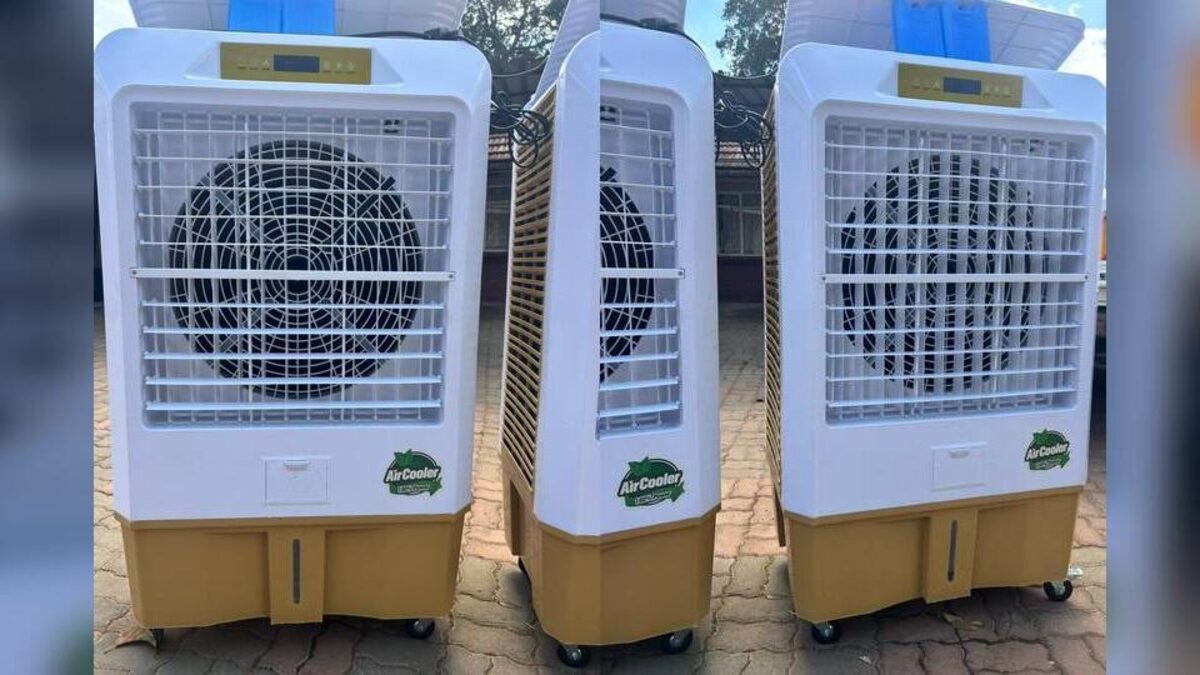
The short answer is yes, and particularly well in Zimbabwe — but the reason why is worth understanding, because it also tells you when they will disappoint you. Anyone who tells you an evaporative cooler is the answer in every situation is selling rather than advising.
How the cooling actually happens
An evaporative air cooler keeps a set of honeycomb pads wet and pulls air through them with a fan. As the air passes, some of the water evaporates into it, and evaporation takes heat out of the air to do so. The air comes out cooler and moving.
The size of that temperature drop depends almost entirely on one thing: how dry the incoming air already is. Dry air has plenty of room to absorb water, so a lot evaporates and the drop is substantial. Air that is already close to saturated cannot absorb much more, so little evaporates and the drop is small.
Why Zimbabwe’s hot season is close to ideal
Zimbabwe’s heat arrives in the dry build-up before the rains — roughly August through to the break of the wet season in November. That is hot, dry air, which is the precise condition evaporative cooling is designed for. It is also, conveniently, the only time of year most people here actually want cooling.
The hotter parts of the country make the case more strongly still. Kariba and the Zambezi valley, Beitbridge, Chiredzi and the Lowveld, Hwange and Victoria Falls all run considerably hotter than the highveld through those months, and all of them are dry through that stretch. These are the places where a cooler stops being a comfort measure and becomes the difference between a function that works and one people leave early.
When they are not the right answer
Once the rains settle in, humidity rises and the cooling effect narrows. A cooler running in genuinely humid conditions still moves a lot of air, which helps, but it is no longer the transformation it is in October. By that point the heat has usually broken anyway.
They are also the wrong choice for a small sealed room you want genuinely cold — a server room, a bedroom, a closed office. That is a job for a refrigerant air conditioner. And they are the wrong choice if what you actually have is a ventilation problem rather than a heat problem: a room with no air movement and no fresh air needs air exchange, and a cooler is not a substitute for opening the place up.
One more honest limitation: they need water and somebody to top the tank up on a long hot day. If nobody on site can do that, plan for it rather than discovering it three hours into your event.
What a realistic expectation looks like
A properly sized set of commercial units in a marquee on a hot dry afternoon makes an immediate and obvious difference — guests notice it, and they stop fanning themselves with the programme. What it does not do is turn a marquee into an air-conditioned boardroom, and anybody promising that is overselling.
The other half of the expectation is quantity. One unit cools the area it is aimed at, not the whole tent. Coverage comes from placing several units to move cooled air across the seated area. This is the most common reason people conclude that air coolers “do not work” — they hired one where the space needed five.
The practical takeaway
For events and business premises in Zimbabwe during the hot months, evaporative coolers are the right tool for most spaces — as long as they are the right size, there are enough of them, and someone keeps water in them. Get those three things right and they work extremely well.
We hire commercial units out in Harare and nationwide, and we would rather tell you the number your venue actually needs than quote you one unit and let you find out.
Frequently asked questions
Do air coolers work in humid weather?
Less well. Evaporative cooling depends on dry air having room to absorb water — in humid conditions less water evaporates so the temperature drop is smaller, and the unit behaves more like a strong fan. In Zimbabwe this rarely matters, because our hot season is the dry build-up before the rains and the humidity only climbs once the heat has broken.
How much cooler does an air cooler actually make a space?
It depends on how dry and how hot the air is, how open the space is and how many units are running relative to the area. On a hot dry afternoon in a marquee with a properly sized set of commercial units, the difference is immediate and obvious to guests. It will not turn a marquee into an air-conditioned boardroom, and anyone promising that is overselling.
Is an air cooler better than a fan?
For heat, yes. A fan moves air without lowering its temperature, so on a genuinely hot day it circulates hot air. An evaporative cooler lowers the temperature of the air it delivers and moves it, which is why it changes conditions in a room full of seated people and a fan does not.
Do air coolers need water topped up during an event?
Yes. The tank is filled at setup and needs topping up through a long hot day. Make sure the units are reachable and that somebody on site knows where the water is — it is a small thing that is easy to plan and annoying to discover mid-event.
Need a hand with your event?
Tell us what you're planning and we'll recommend and supply the right equipment.
Get a Quote