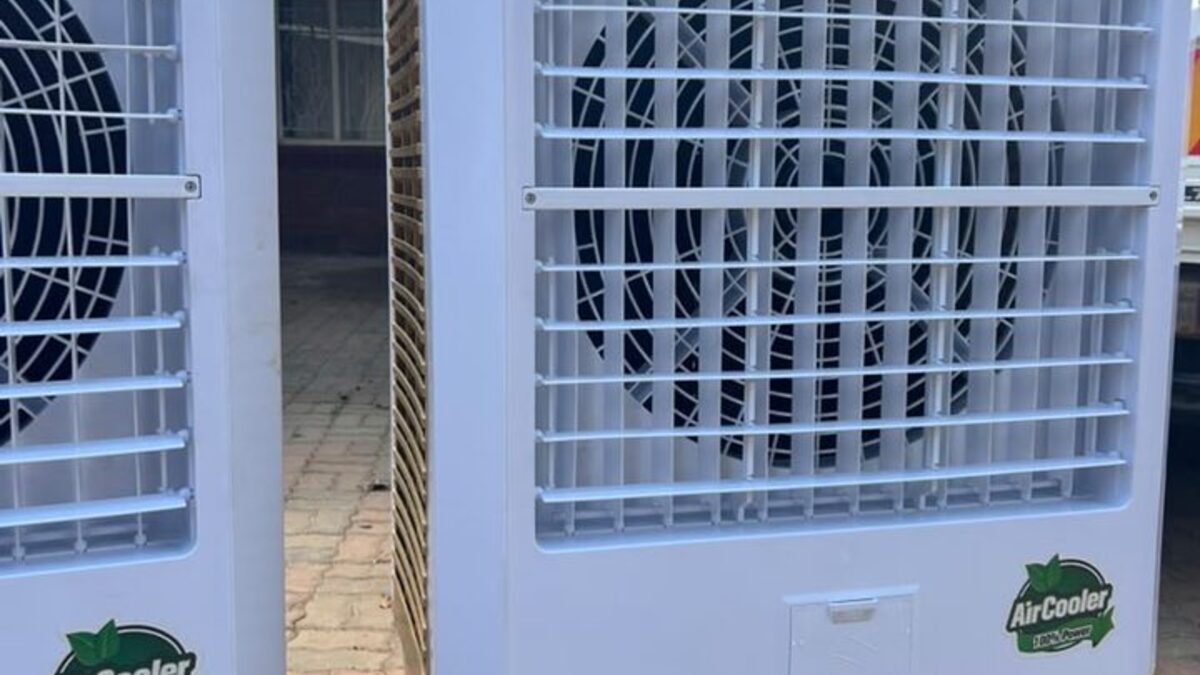
The most common cooling mistake at Zimbabwean events is not choosing the wrong kind of machine — it is hiring one of the right machine for a space that needed five. The guests stay hot, and everyone concludes that air coolers do not work. They do. There just were not enough of them.
An air cooler cools where it is pointed
This is the mental model to start from. An evaporative cooler does not fill a room with cold air the way an air conditioner eventually does in a sealed space. It produces a stream of cooled moving air, and it cools the people in that stream.
So the useful question is not “how big a cooler do I need for this marquee?” but “how do I get cooled moving air across all of the seated area?” The answer is almost always several units, placed around the space, rather than one larger one working harder.
The factors that actually change the number
Floor area is the obvious starting point, but it is not the only thing. How open the space is matters a great deal — a marquee with all sides down behaves differently to one open on two sides, and a hall with the windows shut differently again.
Guest numbers matter more than people expect, because people generate a surprising amount of heat. Two hundred seated guests in a marquee raise the temperature inside it noticeably over the course of an hour, and a room that was comfortable during setup will not be comfortable once it is full.
Time of day matters. A midday wedding lunch under canvas in October is a much harder cooling problem than the same marquee at seven in the evening, and it is the case where ice packs in the tanks are worth the trouble.
Finally, layout. A long narrow marquee needs units distributed down its length. A wide one needs them across the sides. A hall with a stage at one end usually wants units at the back blowing forward, because units at the front tend to cool the first three rows and the speaker.
Placement beats quantity
Given a fixed number of units, where they go makes more difference than almost anything else. Ranged around the perimeter and angled inward across the seating is the general rule for marquees — it gives you air movement across the whole seated area rather than a cold corridor down one side.
Keep them out of the aisles and off the cable runs, keep them reachable for topping up, and — if there is a sound system, which at our events there always is — keep them out of the immediate line of the microphones. A cooler roaring away two metres from a lectern will end up in every recording of the speeches.
For church halls and conventions, units at the back and along the sides work better than units at the front, because the congregation is the heat source and the air needs to move through them rather than past the pulpit.
Do not forget the power
Individually these units are undemanding — far less than an air conditioner — but several of them plus a sound system plus lighting adds up. If you are running on a generator, the coolers need to be counted in the load when it is sized.
This is the single most commonly forgotten item in an event power calculation, and the consequences show up at the worst possible moment, because the generator trips when everything is running at once — which is during your event rather than during setup.
Just ask for the right number
The practical answer is to tell your supplier the venue dimensions, whether the sides are open or closed, how many guests you expect and what time of day the event runs, and let them tell you the number.
A supplier who quotes you one unit for a two-hundred-guest marquee without asking any of those questions is quoting to win the job rather than to solve your problem. We would rather give you the number that works and let you decide, than the number that makes the quote look cheapest and leave your guests uncomfortable.
Frequently asked questions
How many air coolers do I need for a marquee?
It depends on the marquee footprint, how open the sides are, the guest count and the time of day — a midday function needs considerably more cooling than an evening one in the same tent. What is certain is that one unit will not cool a large marquee; coverage comes from several units placed around the perimeter and angled inward. Send your supplier the dimensions and expected numbers and ask them to size it.
Is one big air cooler better than several smaller ones?
Several, almost always. An evaporative cooler cools the stream of air it delivers, so one unit cools where it is pointed no matter how powerful it is. Distributing units around the space gives air movement across the whole seated area, which is what people actually feel.
Where should air coolers be placed at an event?
Around the perimeter, angled inward across the seating, out of the aisles and cable runs, and reachable for topping up with water. Keep them out of the immediate line of any microphones — a cooler close to a lectern ends up audible in the recording of every speech. In halls, units at the back blowing forward usually beat units at the front.
Do air coolers need to be counted when sizing a generator?
Yes, and they are the item most often forgotten. Each unit is undemanding on its own, but several of them alongside sound and lighting adds up, and an undersized generator trips when everything runs at once — which is during the event, not during setup. Tell whoever specs the generator that coolers are part of the load.
Need a hand with your event?
Tell us what you're planning and we'll recommend and supply the right equipment.
Get a Quote