Not every building in Zimbabwe has air conditioning, and not every building that has it has air conditioning that works. Systems break, landlords do not fix them, buildings change use, occupancy grows beyond what the system was designed for, and installing or replacing a fixed system is a capital expense that many businesses cannot justify for three months of heat. This guide covers the practical options for cooling a building when fixed air conditioning is not available, is broken, or cannot cope.
Why buildings overheat in Zimbabwe
The hot season runs from roughly August to the break of the rains in November, with September and October being the worst. During this period, buildings absorb solar heat through the roof and walls all day, and concrete and steel hold that heat into the evening. A building that is comfortable in the morning can be unbearable by two in the afternoon.
In the hottest areas of Zimbabwe — Victoria Falls, Kariba, the Lowveld, Beitbridge — buildings overheat more severely because the ambient temperature starts higher. A warehouse in Kariba in October is not the same problem as a warehouse in Harare. But even in Harare and Bulawayo, a building without working air conditioning becomes a problem during the build-up months, especially when it is full of people.
Option one: portable evaporative air coolers
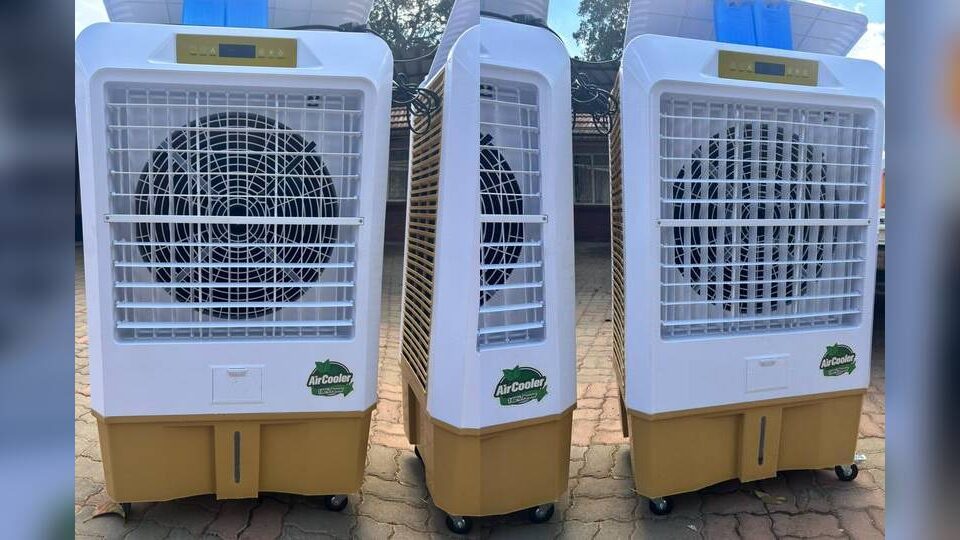
The most effective way to cool a building without installing fixed air conditioning is a mobile evaporative air cooler — the unit commonly called a portable aircon, an aircon fan, a cold fan or a desert cooler. These are chest-height units on castors that plug into a standard wall socket. A pump wets honeycomb pads, a fan draws air through them, and the evaporation drops the air temperature before the fan pushes it across the room.
For offices, shops, salons, clinics, churches, warehouses, workshops and factory floors, these units fill the gap left by missing or broken air conditioning without any installation, ductwork or landlord's permission. They are rented by the week, the month or the season, and returned when the heat is over.
The key advantage for buildings is that they work whether the windows are open or closed. Most Zimbabwean buildings in the hot season have windows and doors open, and a conventional split aircon is defeated the moment you open a window because it needs a sealed space. An evaporative cooler does not care — it delivers a stream of cooled air regardless of what is happening with the building envelope.
Option two: fans
A fan moves air. It does not lower the air temperature, but air movement creates a wind-chill effect that makes a room feel cooler than it is. Tower fans, pedestal fans and ceiling fans are the cheapest option and they help — but there is a limit to what they can do when the air itself is thirty-five degrees.
For a building that is mildly warm, fans may be enough. For a building that is genuinely hot — a concrete office block in Harare in October, a tin-roofed warehouse in Kariba, a church hall packed with a congregation in Bulawayo — fans alone usually are not enough, and you need the step up to evaporative cooling.
A practical middle ground is to combine: an evaporative air cooler delivering cold air into the hottest zone of the room, and a fan circulating that cooled air further. This extends the reach of the cooler without needing more units.
What about the building itself?
If you own the building, there are physical things that reduce heat gain and make any cooling equipment work harder. Reflective roof paint or coating reduces solar heat absorption through the roof, which is the single biggest source of heat in a single-storey building. External shade — trees, shade cloth, awnings over windows — stops sunlight hitting the walls and glass directly.
Cross-ventilation helps enormously. If you can open windows or doors on opposite sides of the building, natural airflow carries hot air out and draws cooler air in. This is free, it works well in the early morning and late afternoon, and it makes any air cooler you add far more effective.
Closing blinds or curtains on sun-facing windows blocks radiant heat. Running heat-generating equipment — servers, ovens, production machinery — in the coolest part of the day or in a separate space keeps its heat contribution out of the occupied areas.
Hiring versus installing air conditioning
Installing fixed air conditioning is the right answer when the building will need cooling every year for the foreseeable future and the owner is willing to invest in it. It is the wrong answer when the building is rented, when the system would only be needed for three months of the year, when the occupancy is temporary, or when the cost cannot be justified against the value of the cooling.
Hiring portable air coolers covers the hot months without the capital cost. You pay for the weeks or months you use, you store nothing through the rest of the year, and there is no maintenance, no gas refills, no repairs. For a lot of Zimbabwean businesses — especially those in rented premises, seasonal operations, and buildings where the landlord will not fix the existing system — hire is the practical answer.
If the building needs cooling every day through every hot season indefinitely, buying your own units or installing a fixed system pays back over two or three seasons. We are happy to advise honestly on which makes more sense for your situation.
Building cooling in the hottest areas
Victoria Falls and Kariba are the hottest areas in Zimbabwe where buildings need cooling, and evaporative coolers work best here because the air is driest. A warehouse, office or lodge in the Zambezi valley in October is a genuinely difficult working environment without cooling, and portable aircon units make a real difference.
Bulawayo and the Matabeleland towns are the next hottest zone, with dry heat that suits evaporative cooling well. Harare and the Mashonaland plateau are milder but still hot enough from September onwards that buildings without working air conditioning become uncomfortable, and staff productivity drops noticeably.
JMG Audio delivers portable air coolers for buildings in all four areas — Harare with same-day delivery, and Victoria Falls, Kariba and Bulawayo on planned runs with transport itemised separately. If your building needs cooling and does not have it, talk to us before the season rather than during it.
Frequently asked questions
Can I cool a building without installing air conditioning?
Yes. Portable evaporative air coolers — portable aircon units — plug into a standard socket and cool a room without any installation, ductwork or permanent changes to the building. They work with open windows and doors, and they are hired for the season and returned when the heat is over.
Do air coolers work in offices and shops?
Yes. Evaporative air coolers work in offices, shops, salons, clinics, churches, warehouses, workshops and any indoor space. They are especially useful in buildings with open windows, where a conventional split aircon would be defeated.
Is it cheaper to hire or buy an air cooler for a building?
Hiring is cheaper if you only need cooling for the three-month hot season each year. Buying makes sense if you would use it most days for years. Many businesses hire for a season or two to see how much difference it makes before committing to a purchase.
Can I hire an air cooler for my church in Zimbabwe?
Yes. Churches are one of the most common building types we hire coolers for. A packed congregation generates enormous body heat, and most church halls have no air conditioning. Evaporative coolers work with the doors and windows open, which is how most churches operate in the hot season.
Need a hand with your event?
Tell us what you're planning and we'll recommend and supply the right equipment.
Get a Quote